

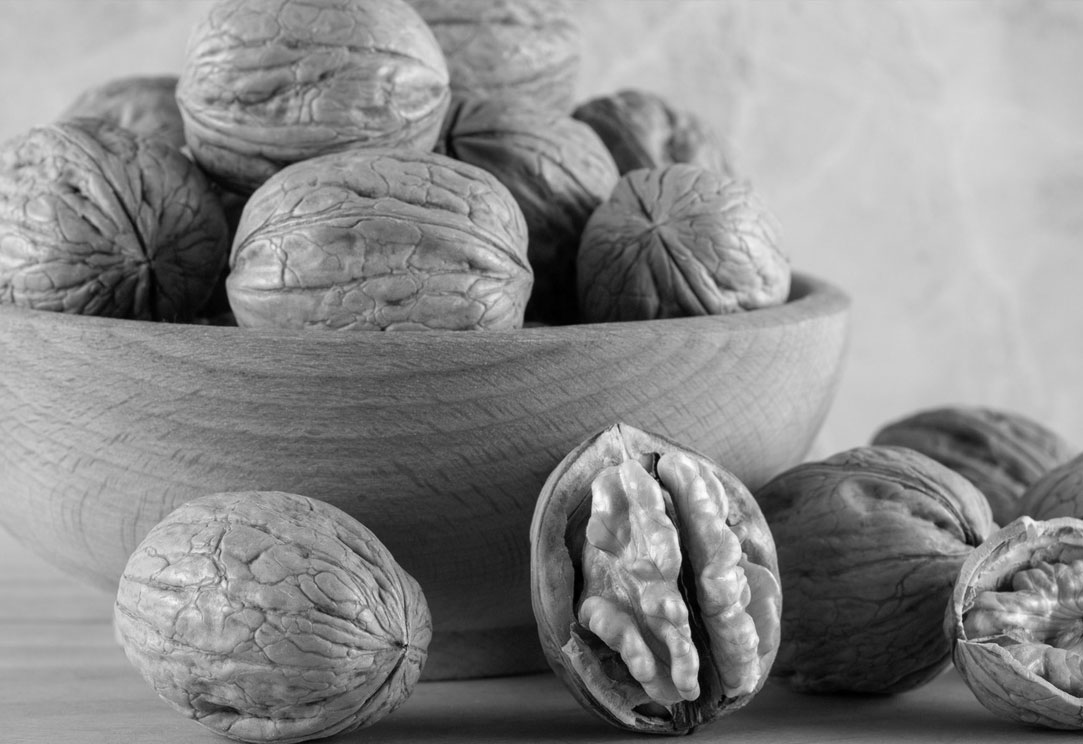

Walnuts, also known as English walnuts, French walnuts, Persian walnuts, or by their scientific name, Juglans regia, likely originated in Asia Minor. Walnuts have been eaten for many centuries and were consumed in both ancient Greece and Rome; they can even be seen preserved in Pompeii’s Temple of Isis. They are also thought to have reached ancient China around 200 BCE, possibly arriving there from Kashmir. Walnuts have long been associated with the brain. According to the Doctrine of Signatures used in Medieval times, walnuts were used for treating head or brain-related ailments because of their physical resemblance to brains. However, 1393’s Le Menagier de Paris recommended the exact opposite, suggesting that walnuts may cause headaches, and Pliny the Elder wrote in his 1st century tome, Natural History, that walnut trees gave off a poison that could bring about a “heaviness of the head.” Walnuts were initially popularized in Europe after the Crusades introduced Arab foods to Western Europe; for example, the practice of making sauces with walnuts was quickly adopted. However, despite the common use of the name English walnuts, these nuts were not widely appreciated in England until after World War I, but were broadly embraced in France much earlier. Most of the walnuts consumed in America were initially imported from Spain and then cultivated by monks in Californian missions (today, California is still the U.S.’s largest walnut supplier.) Notably, while black walnuts (Juglans nigra) are native to North America, they have never been widely consumed because they are exceedingly difficult to crack open. Today, walnuts are extremely popular in the United States and around the world.

Your go-to guide for weird history facts
Subscribe to the FREE daily email that makes learning about history fun.