

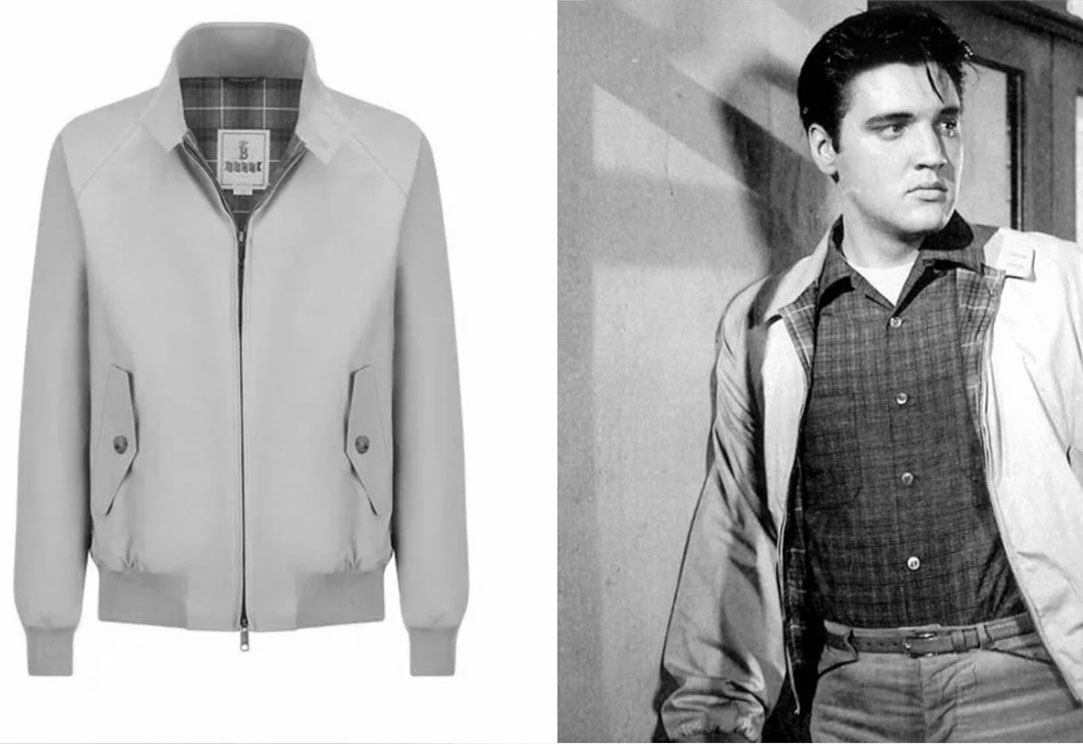

In 1930s England, clothiers John and Isaac Miller began selling a range of high-quality coats and jackets under the brand name Baracuta. While at the Lancashire Golf Club one day, they noticed their Baracuta rain jackets weren’t suited for golfing, as the long design interfered with the swing. To address this, they created the G9 Jacket, which featured a waist-high length, rain-resistant material, elasticated cuffs, and a zip closure. Shortly after the jacket’s initial launch, John Miller asked Lord Lovat, the 24th Chieftain of the Scottish Fraser Clan, for permission to use the Fraser clan’s tartan as the lining for the coat, which further added to its appeal. In the 1940s, the Baracuta G9 was exported to the United States, where it caught on among golfers, including celebrities like Bob Hope and Bing Crosby. In 1947, a U.S. company called McGregor released an American version of the jacket called the Drizzler, which lacked the tartan lining and featured a point collar rather than a stand collar, but was otherwise quite similar. Other versions were soon created, too. The look was popularized by James Dean in 1956’s Rebel Without a Cause, Elvis Presley in 1958’s King Creole, and Steve McQueen on the front cover of LIFE magazine in 1963 (and again in 1968’s The Thomas Crown Affair). The term “Harrington” was first introduced in the 1960s, after the Baracuta G9 was worn by Rodney Harrington, a character played by Ryan O’Neill in the soap opera Peyton Place. Reportedly, a purveyor named John Simons marketed his stock of the Baracuta G9 as the “Rodney Harrington Jacket” and the name stuck. From mainstream to alternative, many groups have since adopted the Harrington jacket as part of their look, including those outside the U.S. and Britain (it is particularly popular in Japan). Today, the Harrington jacket remains one of the world’s most widely worn menswear items.
Your go-to guide for weird history facts
Subscribe to the FREE daily email that makes learning about history fun.