

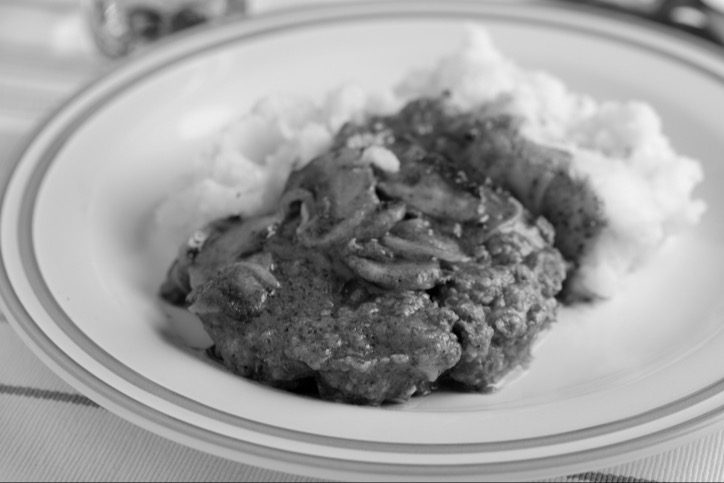

While Salisbury steak is most closely associated with TV dinners in the 20th century, the dish was actually first served as a remedy for health issues during the Civil War era. A 19th century physician from New York named James Salisbury was highly interested in the link between diet and health. He began running a series of experiments, feeding volunteers single-food diets for weeks at a time. At the end of these experiments, he would give them each a 10-ounce steak with butter, salt, and pepper, and then noted in The Relation of Alimentation and Disease (1888) that this seemed to make them feel the best. He applied his research when the Union army asked him to recommend ways to keep soldiers healthy. Because most soldiers were living off hardtack, they were prone to weakness, gait disorders like locomotor ataxy, and extreme digestive upset. Salisbury recommended feeding these ailing soldiers a diet of mostly meat until their symptoms improved. More specifically, he recommended his own recipe for “muscle pulp of beef,” which featured chopped lean beef made into hamburger-like cakes and broiled; permitted seasonings included butter, pepper, salt, Worcestershire sauce, and lemon. After the Civil War ended, the recipe became known as Salisbury steak. As Salisbury's recommendations were published more widely, his ideas spread throughout America and into the United Kingdom. There, fad diets were already being embraced, and thus Salisbury steak became quite popular. In the 20th century, Salisbury steak was also quite popular, although not as a health food, but rather as a quick and easy dish that offered good amounts of protein for a relatively low cost. During World War I and World War II, Salisbury steak was often preferred over hamburgers due to anti-German sentiment and the German-sounding name of the latter. Additionally, when the government published the Cookbook of the U.S. Navy in 1945, the book included a recipe for Salisbury steak, in part because it was hearty, cheap, and easy to make in massive batches. In the postwar period, Salisbury steak became a staple in American TV dinners and was integrated into the cuisines of both Hawaii and Japan. Today, Salisbury steak has made a bit of a comeback and is often served as comfort food, though modern recipes are far less plain than Salisbury’s original concept and are typically accompanied by a flavorful mushroom sauce or gravy.

Your go-to guide for weird history facts
Subscribe to the FREE daily email that makes learning about history fun.