

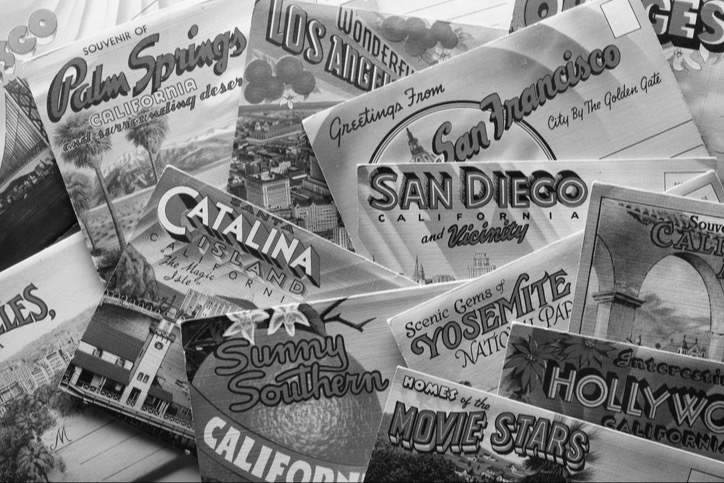

Before postcards, people sent mailed cards, often sealed in envelopes with images printed on them, through the mail. This practice evolved into sending postcards when, on February 27, 1861, Congress passed an act allowing lightweight, privately printed cards to be sent through the U.S. mail. Soon after, John P. Charlton (sometimes referred to as Carlton) copyrighted the first postcard in America. Government postcards went into circulation in 1873 — one side had space for a message (or a printed image with only a very small place for a message, or sometimes a printed image with no space for a message at all) while the other was strictly reserved for the recipient’s address. Privately printed postcards were still allowed to be produced as long as they included the statement, “Private Mailing Card, Authorized by Act of Congress of May 19, 1898.” At the time, postcards could be mailed for just 1 cent! The phrase “Postal Card—Carte Postale” indicated postcards that were allowed to enter the international mail system. The term “Private Mailing Card” was officially replaced by the term “Post Card” (and later, “postcard”) in 1901. In 1907, the Universal Postal Union announced that postcards produced by governments of member nations as well as those sent within the United States could have messages on the left half of the address side for the very first time. This update made postcards an extremely popular way to send brief messages and gave rise to the “Golden Age of Postcards,” which lasted from 1907 to 1915. Around the same time, “real photo” postcards debuted; they were first produced using a special Kodak “postcard camera,” which could print postcard-sized negatives of photographs. Because German printers produced most postcards, the outbreak of World War I meant that American printers became dominant in the market for the first time. Postcards from this era typically featured a white border, which was done to save on printing ink. Unfortunately, because American printers had less sophisticated technology than German printers, the quality of postcards declined and public interest in them waned somewhat. In the 1930s, new printing processes made it possible to print postcards on material that resembled linen. Printers like Curt Teich & Co. became internationally famous for this type of postcard. In 1939, photochrome postcards were introduced when the Union Oil Company began offering them in western service stations. While production slowed during World War II, these photorealistic, colorful postcards dominated the market in the postwar period. Photochrome postcards are the type most familiar to us today and are still often sold in tourist shops. While postcards are no longer widely used to send messages through the mail, many people still collect them as travel souvenirs.

Your go-to guide for weird history facts
Subscribe to the FREE daily email that makes learning about history fun.