

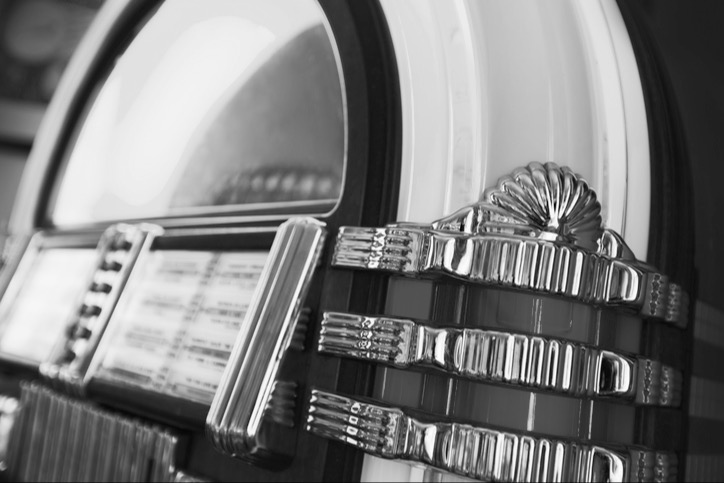

Jukeboxes get their name from "juke joints,” which were once popular hangouts for people to drink and dance to music. We get the word “juke” or “joog” itself from the Gullah Geechee people, descendants of slaves living in the coastal areas of North Carolina, South Carolina, Georgia, and Florida, who originally used the term to mean “disorderly” or “rowdy.” In 1877, Thomas Edison developed a machine that acoustically reproduced sound that could then be heard through a listening tube. In 1890, Louis Glass invented the “nickel-in-the-slot player,” which featured four stethoscope-like tubes attached to an Edison electric phonograph that was fitted inside an oak cabinet, allowing four different listeners to plug into the same song at the same time; it was patented under the name “Coin Actuated Attachment for Phonograph.” The first machine was installed at San Francisco's Palais Royale Saloon in November 1899, and in the 1890s, more machines began appearing in phonograph parlors and gathering places all around the country. However, the first true jukebox didn’t come about until 1906, when the Gabel Automatic Entertainer made its debut. The machine was coin-operated and offered multiple selections with a visible record-changing mechanism. Then in 1927, the Automated Musical Instrument Company introduced the first electronically amplified jukebox, changing the course of entertainment. A room full of people could suddenly be entertained with their choice of song for the price of a nickel. The machines quickly caught on and competitors like the Seeburg Corporation began making their own jukeboxes. Notably, it was Justis Seeburg’s Seeburg Corporation that developed the Audiophone, the automatic phonograph, and it was his industrial designer who first introduced illuminated plastics, creating the version of the jukebox we would recognize today. The company began offering jukeboxes that used 45 rpm records and later put out models that used CDs. Jukeboxes had their heyday between the late 1940s and 1960s, but they can still be seen in diners and other vintage establishments today, and they are now considered an emblem of Americana.
Your go-to guide for weird history facts
Subscribe to the FREE daily email that makes learning about history fun.