

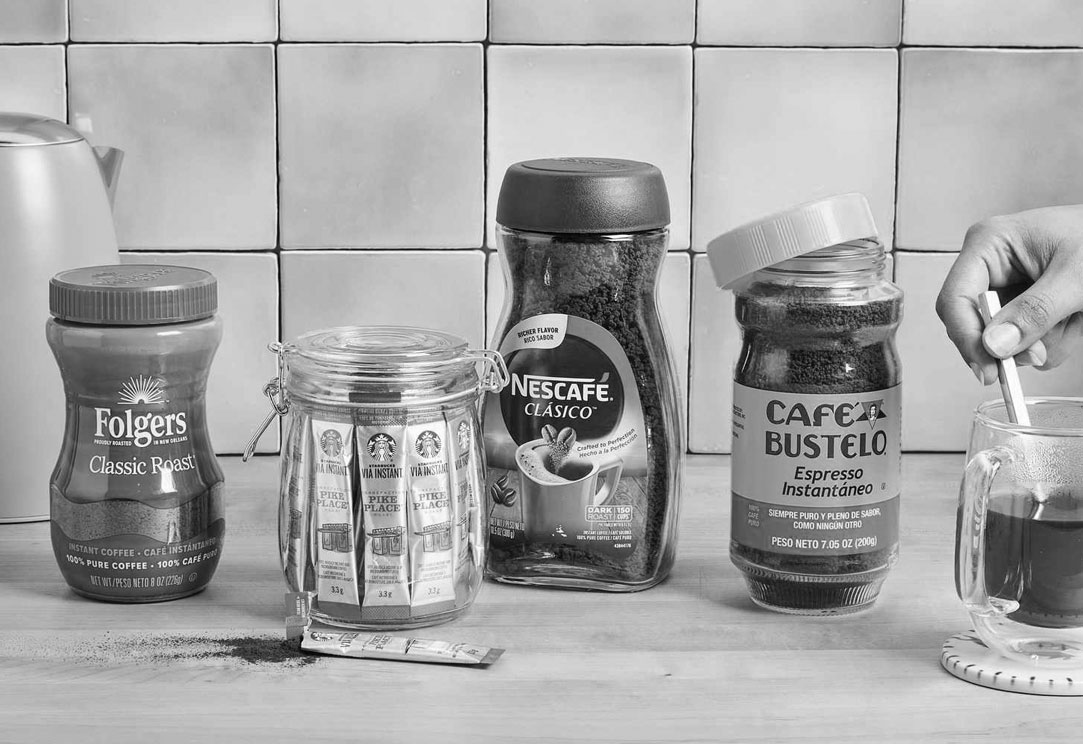

Instant coffee was first created by a man named David Strang, who received a New Zealand patent for his soluble coffee powder in the late 1800s. Shortly afterwards, a Japanese chemist living in Chicago named Dr. Satori Kato created an instant coffee based on methods he’d previously developed for making soluble tea. He then opened the Kato Coffee Company and presented his product at the Pan-American Exposition in 1901. Then a man named George Washington came along. Born in Belgium, he moved to Guatemala City and invented a dried instant coffee powder that only required hot water. He spent 3 years perfecting the process of creating dehydrated coffee crystals and patented his invention in 1909. Washington was responsible for launching the first widely available instant coffee product. He originally called his company Red E Coffee but quickly changed it to the George Washington Coffee Refining Company. Shortly after World War I broke out, packets of instant coffee were added to each soldier’s rations; much of it was provided by the George Washington Coffee Company. While the instant coffee was popular among soldiers, the flavor was subpar, so instant coffee wasn’t particularly popular after the war ended. In 1938, Nestlé introduced a novel processing technique (spray drying) and began offering Nescafé instant coffee. When World War II broke out, the U.S. military purchased over 1 million cases of Nescafé instant coffee in a single year. Instant coffee remained relatively popular in the postwar period and several coffee companies, including Nestlé and the George Washington Coffee Company, began selling their products on grocery store shelves. The brands were joined by Maxwell House and Folgers, both of which released their first instant coffee products shortly after the war. In the 1960s, Nestlé introduced yet another a new processing technique called freeze drying, creating a newer type of instant coffee. Today, instant coffee is still widely consumed in the U.S. and around the world and is particularly appreciated for its portability and convenience.
Your go-to guide for weird history facts
Subscribe to the FREE daily email that makes learning about history fun.