

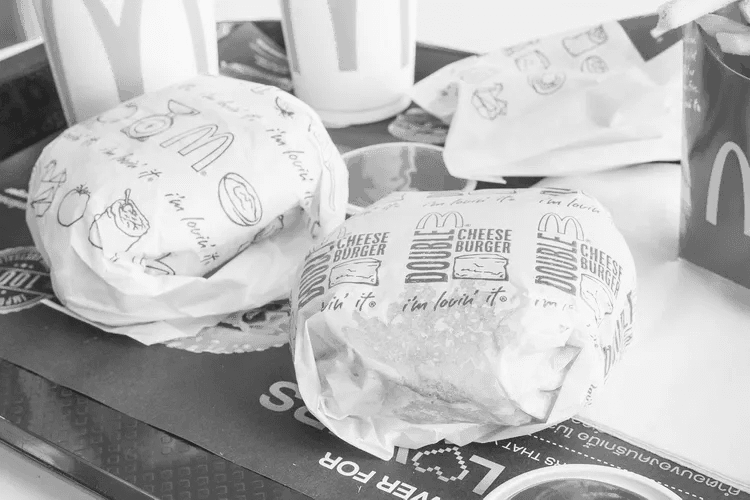

The practice of wrapping food to make it more portable has ancient origins. Early humans would wrap their meals in leaves or husks to make them more travel-friendly. When fish and chips became popular in London in the mid-1800s, portions were often wrapped in newspaper before being handed over to hungry customers. And ever since hamburgers were invented around the turn of the 20th century, cooks have been wrapping them in paper. In fact, greaseproof parchment paper was created around the same time and was deemed perfect for wrapping hamburgers in, so it became the standard. At the time, burger wrappers were typically made from butcher shop paper, wood pulp, and a sulfuric acid coating. Over time, the materials were improved upon and now often feature an insulating foil layer, but the original concept behind burger wrappers — keeping food warm and portable while protecting customers' hands from grease — hasn’t changed much. Around the start of the 1950s, McDonald’s realized that burger wrappers could be used for advertising and began printing on them for marketing purposes. The first design featured an image of the company’s then-mascot, a chef named Speedee. As other fast-food burger joints gained popularity, they too printed their company logos and mascots on their burger wrappers. Today, the practice of using burger wrappers for advertising continues and many eateries routinely print their logos or special promotions on them.
Your go-to guide for weird history facts
Subscribe to the FREE daily email that makes learning about history fun.